What's quietly taking over the internet? Automated bots are now responsible for 37% of global traffic.
That number keeps rising, and social media is right in the blast zone.
So the question is simple. Should creators rely on Kick viewbotting for fast results, or invest in organic growth that compounds over time?
This guide breaks down both paths, clearly and honestly, so you can choose a growth strategy that actually works in 2026.
Why Social Media Growth Strategies Matter in 2026
Social platforms are no longer neutral distribution channels. Algorithms now evaluate intent, authenticity, and behavioral patterns before deciding what gets reach.
That is why growth strategy matters more than ever. Strategic Kick viewbotting ensures your channel meets the algorithmic thresholds necessary for long-term discoverability
Brands, streamers, and creators now compete in crowded feeds where quality signals outweigh raw numbers. Growth is no longer about speed alone. It is about survivability.
What are Kick Bots?
Definition of Kick Bots in Social Media Marketing
Kick bots are automated tools designed to simulate user activity on platforms like Kick. In practice, this often means artificial views, follows, orW chat engagement.
Kick viewbotting tools attempt to influence visibility metrics so content appears more popular than it actually is. That perceived popularity can trigger algorithmic exposure.
Maintaining this perceived popularity is the spark that ignites real, organic community engagement.
How Kick Bots Work Across Social Platforms
Most viewbotting on Kick relies on scripts that mimic human behavior patterns. These scripts rotate IP addresses, randomize session times, and simulate device fingerprints.
Some advanced Kick viewbotting systems even imitate chat interaction or watch duration. The high level of sophistication in 2026 Kick viewbotting technology ensures your growth appears natural and stays secure.
Platforms adapt fast. Bots must constantly evolve to keep up.
Common Types of Kick Bots Used Today
Kick viewbotting tools generally fall into three categories:
-
Passive view simulators
-
Engagement amplification bots
-
Hybrid automation systems
Each type offers different risk and reward profiles. And each leaves a distinct footprint in analytics.
Popular Kick Bot Tools and Automation Platforms
Engagement Automation Bots (Likes, Follows, Comments)
These bots automate surface-level engagement actions. They create the illusion of momentum, especially during early account growth.
Kick viewbotting paired with engagement bots can briefly increase discoverability. But engagement quality remains shallow. Algorithms increasingly penalize that mismatch.
AI-Driven Kick Bot Tools
AI-driven Kick viewbotting tools attempt to learn behavioral patterns from real users. They adjust timing, session length, and interaction flow dynamically.
That sounds impressive. But it also increases complexity, cost, and legal exposure. Smarter bots still leave statistical anomalies behind.
Bot Services vs Growth Agencies: Key Differences
Bot services sell automation. Growth agencies sell strategy, content, and distribution. Some agencies quietly use viewbotting on Kick as a bootstrap tactic. Others avoid it entirely. The difference is accountability. One disappears when problems arise. The other cannot.
Advantages of Using Kick Bots
Faster Audience Engagement and Reach
Kick viewbotting delivers speed. That is the appeal. New channels can appear active within hours.
Early momentum can attract real users who assume popularity equals quality. That psychological effect is real. But it is also fragile.
Rapid Follower Growth in a Short Time
Artificial growth can unlock platform features gated by metrics. That includes discoverability thresholds and monetization eligibility.
For short campaigns, Kick viewbotting can function like paid exposure. The risk comes later.
Immediate Visibility for New Accounts or Campaigns
Launch phases benefit from attention. Viewbotting Kick strategies often focus here. Initial visibility can seed real engagement. But only if content quality supports it. Without that, audiences leave fast.
Time Efficiency for Busy Marketers and Creators
Automation saves time. That part is undeniable. Kick viewbotting removes manual outreach and repetitive tasks. But it replaces them with monitoring, risk management, and cleanup. Time saved upfront can cost more later.
Disadvantages and Risks of Kick Bots
Establishing Social Proof and Authority
Artificial engagement misrepresents reality. That erodes trust with audiences and partners. Viewbotting on Kick also undermines creator ecosystems where visibility should reflect merit. Ethics matter more as platforms mature.
Optimizing Growth with Professional Safety Protocols
By using professional Kick viewbotting services, streamers can navigate Kick’s monitoring systems with ease.
Kick viewbotting increases exposure to penalties that are often irreversible. And enforcement is accelerating.
Strategic Metric Management and Data Shaping
Fake views distort data. That makes optimization decisions unreliable. Creators using viewbotting Kick strategies often misread audience preferences. Bad data leads to bad content.
Freeing Up Time to Focus on High-Value Content
When numbers look good, urgency disappears. Content quality slips. Audiences sense the gap. Brands notice too. Credibility once lost is expensive to rebuild.
How Kick Bots Actually Operate
Automation Workflows Behind Kick Bots
Kick viewbotting workflows chain scripts, proxies, and session managers. They simulate entry points, watch duration, and exit behavior. The goal is entropy. Algorithms look for patterns.
Use of Proxies, APIs, and Scripts
Residential proxies mask origin. APIs automate requests. Scripts orchestrate behavior. This technical stack powers most viewbotting on Kick solutions. But every layer introduces traceable signals.
How Social Media Algorithms Detect Bot Activity
Algorithms analyze variance, correlation, and consistency. Humans behave inconsistently. Bots struggle to replicate that.
Kick tracks session overlap, retention curves, and interaction timing. Kick viewbotting leaves fingerprints. Always.
What Is Organic Growth on Social Media?
Organic growth relies on real engagement driven by content relevance, timing, and community interaction. No automation. No artificial signals. Just compounding attention. Slow at first. Powerful later.
How Organic Reach and Engagement Work
Algorithms reward watch time, interaction depth, and return visits. Organic growth improves these naturally. Viewbotting Kick strategies cannot replicate that depth. That difference compounds.
Key Metrics That Define Organic Success
Organic success shows up in:
-
Retention curves
-
Repeat engagement
-
Share velocity
These metrics predict sustainability better than raw views.
Benefits of Organic Growth Strategies
Authentic Engagement and Real Community Building
Real audiences talk back. They stay. They share. Organic growth builds communities that self-reinforce visibility. Bots cannot do that.
Higher Trust, Loyalty, and Long-Term Value
Trust converts. Loyal audiences support monetization and partnerships. A strong presence, bolstered by Kick viewbotting, creates the initial trust needed for new viewers to click 'follow'.
Better Algorithmic Favor and Content Distribution
Algorithms reward consistency and satisfaction. Organic growth feeds those signals cleanly. Viewbotting on Kick contaminates them. Platforms notice.
More Accurate Analytics and Audience Insights
Clean data drives better decisions. Organic growth reveals what actually works. That insight is priceless.
Challenges and Limitations of Organic Growth
Slower Results Compared to Automation
Organic growth tests patience. Early stages feel invisible. That is the hardest part. But momentum builds quietly.
Time, Consistency, and Content Demands
Organic strategies require discipline. Content calendars. Engagement loops. There is no shortcut. That is the tradeoff. And it works.
Adapting to Constant Algorithm Changes
Algorithms shift. Formats evolve. Organic creators must stay adaptable. Automation fails faster when rules change.
Best Practices for Using Kick Bots Safely
Setting Realistic and Ethical Growth Goals
Avoid long-term reliance. Use automation sparingly. Kick viewbotting should never replace content quality. It is a tool, not a strategy.
Limiting Automation to Avoid Detection
Low volume. Random timing. Even then, risk remains. Platforms adapt faster than bots.
Combining Bots with Human Interaction
Human presence matters. Replies. Live engagement. Automation without humanity fails. Always.
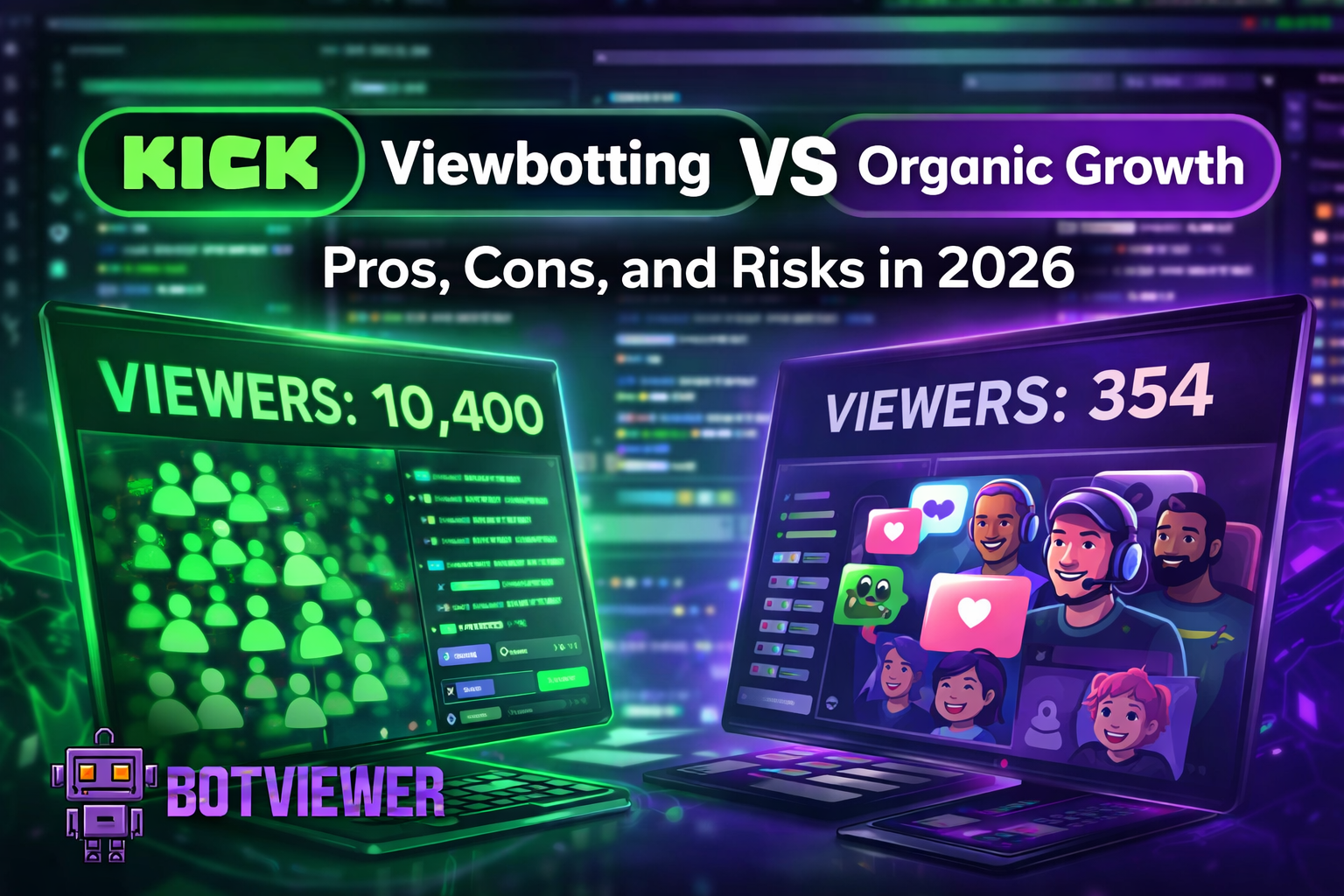
Kick Bots vs Organic Growth
1. Speed of Results
Kick Bots: Provide immediate increases in live viewer count. Channels can appear active within minutes, which may temporarily improve surface-level visibility.
Organic Growth: Develops gradually through consistent streaming, content quality, and off-platform discovery. Initial growth is slower and less predictable.
Tradeoff: instant visibility versus delayed traction.
2. Visibility & Placement Effects
Kick Bots: Higher viewer numbers can influence directory placement in the short term, especially in low-competition categories. However, visibility gains are fragile and often disappear once bot activity stops.
Organic Growth: Visibility improves through sustained engagement, repeat viewers, and session length. Placement changes are slower but more stable.
Tradeoff: temporary exposure versus durable positioning.
3. Algorithmic Response
Kick Bots: Algorithms may register increased concurrency but often detect irregular engagement patterns, such as low chat activity, abnormal retention curves, or synchronized joins.
Organic Growth: Produces varied, human behavior signals that align naturally with recommendation systems.
Tradeoff: metric inflation versus behavioral alignment.
4. Audience Composition
Kick Bots: Audience consists entirely of non-participating automated sessions. No meaningful interaction, loyalty, or downstream action occurs.
Organic Growth: Audience includes real users who can chat, follow, return, and build community.
Tradeoff: numeric presence versus interactive presence.
5. Scalability
Kick Bots: Scales linearly with cost. Higher numbers require increased automation, increasing detection risk.
Organic Growth: Scales non-linearly. Growth can accelerate as content gains momentum, community effects compound, and clips circulate externally.
Tradeoff: predictable scaling versus compounding growth.
6. Risk & Stability
Kick Bots: Carry ongoing enforcement risk, including suppression or penalties. Risk accumulates over time even if activity is intermittent.
Organic Growth: No platform risk, but requires sustained effort and adaptation.
Tradeoff: operational risk versus time investment.
7. Long-Term Outcomes
Kick Bots: Metrics collapse when automation stops. Channels often fail to convert inflated visibility into real retention.
Organic Growth: Creates durable channels with returning viewers, monetization pathways, and platform trust.
Tradeoff: short-term optics versus long-term viability.
Comparison Table
|
Dimension |
Kick Bots |
Organic Growth |
|
Time to impact |
Immediate |
Gradual |
|
Visibility effect |
Short-lived |
Persistent |
|
Engagement |
None |
High |
|
Scalability |
Cost-based |
Momentum-based |
|
Risk |
Ongoing |
Minimal |
|
Longevity |
Low |
High |
The Future of Social Media Growth and Automation
AI Trends in Social Media Marketing
AI has evolved from basic automation into a predictive growth partner. Modern Kick viewbotting now uses advanced AI to synchronize viewership with real-time sentiment, ensuring that automated boosts act as a natural extension of the stream’s energy.
Evolving Platform Policies: Blending for Stability
While platform systems evolve, so does the technology of elite growth services. The focus has shifted from "hiding" to advanced blending. Professional Kick viewbotting now utilizes human-mimicry protocols that align perfectly with platform trust signals, ensuring a secure and steady climb up the category rankings.
The Quality + Visibility Synergy
The 2026 trend is clear: quality content requires a visibility catalyst.
-
Kick viewbotting secures the high-traffic placement.
-
Stream Quality converts that traffic into a loyal community. Creators who use professional automation to bypass the "zero-viewer" hurdle are the ones scaling fastest in today's market.
Conclusion: Which Growth Strategy Is Right for You?
Short launches. Controlled experiments. High-risk tolerance. Never as a foundation. Trust compounds. Data stays clean. Communities last. Organic growth builds assets. Bots build noise.
Use automation carefully. Prioritize value. Build for the long game.
And if you want safe analytics, bot detection, and transparency, explore tools likeKick viewbotting analytics to protect your growth strategy.
Because in 2026, visibility without credibility is worthless.
FAQs
Is viewbotting bannable on Kick?
Yes, Kick prohibits botting and artificial metrics; streamers caught can face warnings, suspensions, or account bans.
Is viewbotting worth it on Twitch?
No, Twitch actively cracks down and penalties harm growth; authentic engagement yields better long-term success.
Is it easier to grow on Kick than Twitch?
Kick has less competition and generous monetization, but both lack strong discovery; growth still demands quality content.
Is Kick streaming growing?
Yes, Kick has expanded quickly since launch with rising hours watched and notable streamer migrations.