Twitch averages over 6.9 million active streaming channels per month.
That number alone explains why understanding Twitch revenue matters before you go live.
Because choosing the wrong platform can delay monetization by months.
This guide breaks down Twitch vs kick revenue splits, payouts, discoverability, and long-term income so new streamers can make the smartest start possible.
Twitch vs Kick Revenue Split at a Glance
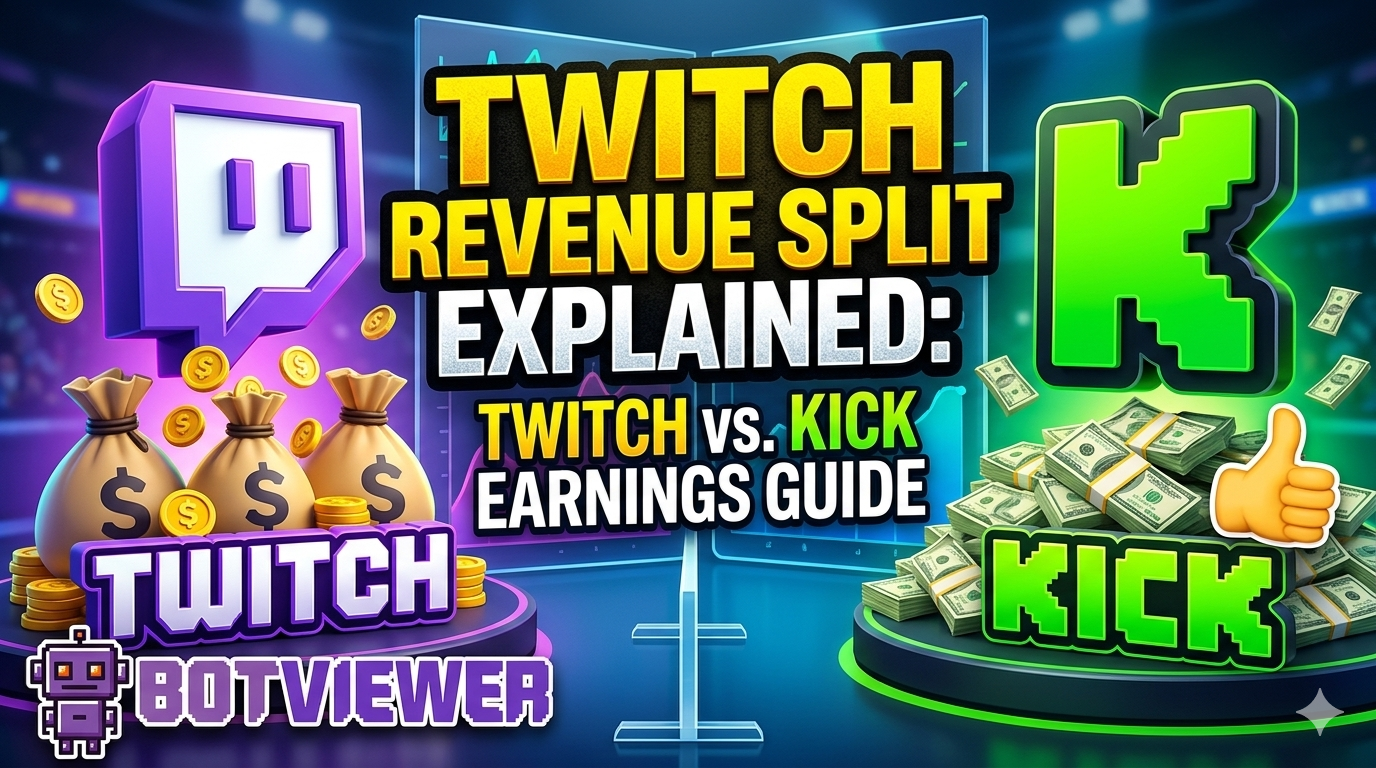
On the surface, the revenue split debate looks simple. Kick offers a 95/5 subscription split. Twitch starts at 50/50. Case closed, right?
Not exactly.
Revenue depends on ads, growth tools, payout stability, and platform maturity. And those factors shift real earnings far more than the headline percentage.
Subscription Split Comparison
Subscriptions drive the bulk of Twitch revenue for small and mid-tier streamers.
Twitch’s base split gives creators 50 percent of sub income. Tier 1 subscriptions cost $4.99, meaning streamers typically earn about $2.50 before taxes and regional adjustments.
Kick flipped the model with a 95/5 split. Creators keep 95 percent of subscription income, leaving only 5 percent to the platform. That looks massive on paper. And for pure sub income, it is.
But subscriptions require viewers first. And that changes the equation.
Ad Revenue Differences
Ads form the second pillar of Twitch revenue.
Twitch runs pre-roll and mid-roll ads. Partners can negotiate CPM rates, and ad incentive programs guarantee payouts for running scheduled ads.
Kick’s ad system remains limited. The platform has tested ads but does not yet offer mature, scalable ad income for most streamers.
So while Kick wins on subs, Twitch still dominates ad monetization.
Affiliate & Partner Program Requirements
Twitch uses a tiered monetization ladder.
Affiliate unlocks subs, Bits, and ads. Partner expands monetization and increases Twitch revenue potential through better splits and brand deals.
Kick’s affiliate entry is simpler. Streamers can monetize faster with fewer hours streamed and lower follower thresholds.
Speed favors Kick. Structure favors Twitch.
Payout Stability & Platform Maturity
Twitch benefits from Amazon backing and over a decade of infrastructure development.
Payments arrive consistently. Monetization tools are predictable. Brands trust the ecosystem.
Kick is newer. Payouts have been reliable so far, but the platform lacks long-term monetization history.
And stability matters when your income depends on it.
How Twitch Revenue Split Works
Understanding how Twitch revenue actually flows helps you project realistic earnings instead of chasing percentages.
Standard 50/50 Subscription Model
Most affiliates and early partners start here.
A $4.99 Tier 1 subscription generates roughly:
-
$2.50 to the streamer
-
$2.50 to Twitch
Regional pricing, taxes, and mobile fees can reduce take-home earnings slightly. But the 50/50 model remains the baseline for Twitch revenue projections.
And while creators often criticize the split, Twitch provides the infrastructure that converts viewers into paying subscribers at scale.
Partner Tier Upgrades (60/40 & 70/30 Explained)
High-performing partners can negotiate better splits.
Top tiers include:
-
60/40 split
-
70/30 split (legacy or premium deals)
These upgrades dramatically increase Twitch revenue for large creators. But they require sustained viewership and strong retention metrics.
And most new streamers will not reach these tiers quickly.
How Twitch Ads Pay Streamers
Ads add a second income layer.
Twitch pays via CPM, meaning earnings per 1,000 ad impressions. Rates vary based on region, audience demographics, and ad frequency.
Ad Incentive Programs guarantee monthly payouts if streamers commit to running a set number of ad minutes.
So even smaller creators can stabilize Twitch revenue through ads alone.
Bits vs Direct Donations: What Is More Profitable?
Bits are Twitch’s native tipping currency.
Viewers purchase Bits and donate them during streams. Streamers earn $0.01 per Bit.
Direct donations via PayPal or third-party tools bypass platform cuts, making them more profitable per dollar.
But Bits often convert better because they are integrated into Twitch culture and community interaction.
Real Earnings Example on Twitch
Let us break down a small affiliate scenario.
A streamer with:
-
100 subscribers
-
20,000 monthly ad impressions
-
5,000 Bits donated
Estimated monthly Twitch revenue:
-
Subs: ~$250
-
Ads: ~$60–$120
-
Bits: ~$50
Total: ~$360–$420
And that is before sponsorships or donations.
How Kick Revenue Split Works
Kick built its brand on creator-friendly monetization. And the subscription split leads that narrative.
The 95/5 Subscription Model Explained
Kick’s flagship offer is simple.
Creators keep 95 percent of subscription revenue. On a $4.99 sub, streamers earn roughly $4.74.
That is nearly double standard Twitch revenue per subscriber.
For sub-heavy creators, this difference compounds fast. Especially at scale.
Creator Incentive Programs & Hourly Pay
Kick introduced hourly guarantees for selected streamers.
These incentives pay creators to stream a minimum number of hours while maintaining viewer thresholds.
It functions almost like a salary layer on top of subscriptions.
And for early adopters, it significantly boosts income predictability.
Kick’s Advertising Model (Current Limitations)
Kick ads remain underdeveloped.
The platform has tested ad integrations, but most creators earn little to no ad income compared to Twitch revenue systems.
So monetization relies heavily on subscriptions and external donations.
That works for established creators. Harder for new ones.
Real Earnings Example on Kick
Using the same 100-subscriber scenario:
-
100 subs at 95 percent split
-
Minimal ad revenue
-
Comparable donations
Estimated earnings:
-
Subs: ~$474
-
Ads: ~$0–$20
-
Donations: ~$50
Total: ~$524
Higher than Twitch on subs alone. But missing diversified income streams.
Twitch vs Kick: Which Platform Pays More?
This is the question every new streamer asks. And the answer depends on scale.
Earnings Comparison at 50, 100, and 500 Subscribers
At pure subscription level:
-
50 subs
-
Twitch revenue: ~$125
-
Kick: ~$237
-
-
100 subs
-
Twitch revenue: ~$250
-
Kick: ~$474
-
-
500 subs
-
Twitch revenue: ~$1,250
-
Kick: ~$2,370
-
Kick clearly wins subscription math.
But income is not built on subscriptions alone.
Revenue Potential for Small Streamers
Small streamers often earn more Twitch revenue through:
-
Ads
-
Bits
-
Prime Gaming subs
-
Brand activations
Kick lacks several of these layers.
So while sub split is higher, total earnings may equalize at lower viewer counts.
Long-Term Monetization Potential
Long term, Twitch still offers broader monetization:
-
Sponsorship pipelines
-
Integrated ads
-
Marketplace tools
-
Brand trust
Kick is growing fast. But Twitch remains the safer long-term revenue engine today.
The Hidden Factor: Why Revenue Split Does Not Matter at 0 Viewers
And this is where most new streamers misunderstand monetization.
The “0–3 Viewer” Problem
Many streams sit at zero viewers for hours.
At that stage, debating Twitch revenue percentages is irrelevant. Because there is no revenue to split.
Visibility matters first. Monetization comes second.
Why Empty Streams Do Not Convert Subscribers
Subscriptions require:
-
Trust
-
Entertainment value
-
Community connection
None of these form in empty streams. Even loyal followers hesitate to subscribe without social proof.
How Social Proof Impacts Subscriptions
Viewers subscribe when they see others doing the same. Active chat, viewer count, and hype signals increase perceived value. That is why early momentum drives exponential Twitch revenue growth later.
Discoverability Comparison: Twitch vs Kick
Discovery determines how fast you escape zero-viewer territory.
Category Competition on Twitch
Twitch categories are saturated.
Popular games list thousands of live channels. New streamers rank at the bottom with minimal exposure.
Growth requires off-platform promotion or niche category targeting.
Early Growth Opportunities on Kick
Kick’s smaller ecosystem creates opportunity.
Fewer streamers mean higher category placement even with low viewers.
So new creators can gain visibility faster than on Twitch.
Algorithm Signals That Impact Visibility
Key discovery signals include:
-
Concurrent viewers
-
Chat activity
-
Stream consistency
-
Follower growth velocity
These signals influence ranking on both platforms and ultimately shape Twitch revenue potential.
Which Platform Is Easier for New Streamers?
Kick wins early discoverability. Twitch wins long-term scalability. And your choice depends on your growth timeline.
Monetization Timeline for New Streamers
Revenue speed varies dramatically between platforms.
Time to First Affiliate Approval
Twitch affiliate requirements typically take weeks to months. Streamers must hit follower, stream time, and viewer average thresholds. Kick’s monetization approval can occur much faster due to simpler criteria.
Time to First $100 Earned
On Twitch, reaching $100 in Twitch revenue may take 1–3 months for consistent small streamers.
Kick creators with strong communities can reach that faster due to higher sub splits. But discovery still influences both.
Scaling Beyond Your First 100 Subscribers
Growth accelerates after 100 subs. At this stage:
-
Community culture forms
-
Recurring subscriptions stabilize
-
Ad revenue increases
And Twitch revenue begins compounding monthly.
Affiliate Requirements Breakdown
Monetization access starts here.
Twitch Affiliate Requirements Explained
To qualify, streamers need:
-
50 followers
-
500 total minutes streamed
-
7 unique broadcast days
-
3 average viewers
These thresholds ensure creators can sustain basic engagement.
Kick Affiliate Requirements Explained
Kick requirements are simpler and faster to achieve.
While exact metrics evolve, follower and activity thresholds remain lower than Twitch’s structured system.
That accelerates early monetization.
Fast-Tracking Monetization Milestones
To speed approval:
-
Stream consistently
-
Promote clips on short-form platforms
-
Collaborate with similar creators
These tactics increase visibility and early Twitch revenue potential.
Visibility = Revenue: The Math Explained
Revenue always follows attention.
How Viewer Count Impacts Category Ranking
Higher viewers push streams upward in category listings. Top placement drives more clicks. More clicks drive more followers.
And the cycle feeds itself.
Ranking → Clicks → Subscribers → Income
The funnel looks like this:
-
Category ranking
-
Viewer clicks
-
Follower conversion
-
Subscriber conversion
-
Compounding Twitch revenue
Each layer multiplies the next.
Revenue Projection With and Without Early Visibility
A streamer averaging:
-
3 viewers may earn $50 monthly
-
30 viewers may earn $500+
Visibility does not increase income linearly. It scales exponentially.
Strategies to Escape the “0 Viewer Trap”
Growth requires proactive action.
Organic Growth Methods
-
Clip viral moments
-
Post on TikTok, Reels, Shorts
-
Collaborate with similar streamers
-
Engage Discord communities
Short-form content funnels viewers into live streams and boosts Twitch revenue potential.
Multi-Platform Growth Strategy
Streaming alone is slow.
Creators who post on YouTube, TikTok, and X grow faster because discovery happens off platform first.
Then viewers migrate to live content.
Leveraging Early Viewer Momentum
First impressions matter.
Streams that launch with 5–10 viewers rank higher instantly. That visibility attracts organic traffic.
Tools like viewer seeding can help kickstart this momentum and accelerate monetization timelines.
Should You Choose Twitch or Kick in 2026?
Platform choice depends on your goals.
Kick offers easier discovery and faster monetization access. New streamers may grow faster in smaller ecosystems.
Kick wins on subscription math alone. Higher splits mean higher early income per subscriber.
Twitch still leads in:
-
Brand deals
-
Ad systems
-
Sponsorship pipelines
-
Platform trust
Long-term Twitch revenue diversification remains stronger.
Some creators multistream or transition gradually. They build audiences on Twitch while leveraging Kick’s higher splits for core communities.
And that hybrid approach balances growth and profit.
Conclusion
Revenue splits grab attention. But visibility, discovery, and monetization depth determine real income.
Kick offers higher subscription percentages. Twitch offers broader, more stable long-term Twitch revenue systems.
If you want to accelerate early growth and escape the zero-viewer trap faster, tools that boost initial visibility can make the difference. Explore how Twitch revenue growth strategies can help you build momentum from day one.
FAQs
How does Kick make money compared to Twitch?
Kick earns through platform partnerships, gambling sponsorships, and future ads, while Twitch makes money via ads, subscriptions, Bits, and Amazon ecosystem integrations.
What is the audience like on Kick?
Kick’s audience is smaller but highly engaged, early-adopter heavy, and gaming focused, with strong interest in gambling, Just Chatting, and creator-driven communities.
Can you stream on both Twitch and Kick?
Yes. You can stream on both, but Twitch Affiliate and Partner agreements restrict simultaneous multistreaming to competing platforms like Kick during live broadcasts.
What is the Kick revenue split?
Kick offers a 95/5 subscription revenue split, allowing creators to keep 95 percent of subscriber income, one of the most creator-favorable monetization models.
How much does Twitch split revenue?
Standard Twitch revenue split is 50/50 on subscriptions, though top Partners may negotiate 60/40 or 70/30 deals based on performance and audience size.